Salons and spas sit in an unusual position. Clients are in the chair for an hour or more with very little to do except look around, which means every ledge, mirror edge, and baseboard gets more scrutiny than in almost any other business. And unlike a restaurant or a shop, the client is physically being handled, so cleanliness reads as a proxy for how carefully the whole operation is run.
There is also a boundary here that matters more than in most industries. Some cleaning in a salon is regulated practice tied to your licence, and it belongs with your licensed staff. The rest is general cleaning. This guide covers where that line sits, what a general cleaning scope should include, and what to specify when hiring in Cincinnati and Northern Kentucky.
The line you should not let a vendor cross
In Kentucky and Ohio, salon sanitation is governed by the state cosmetology board, and specific practices are tied to your licence: disinfecting implements and tools between clients, handling and storing shears, combs and clippers, foot spa and pedicure basin disinfection protocols after every client, and the record-keeping some of that requires.
That work belongs to your licensed staff. It is part of your compliance obligation, it is what an inspector examines, and it is not something to hand to a general cleaning vendor. Any cleaning company that offers to take over implement disinfection or pedicure basin protocols is either misunderstanding the regulations or hoping you do.
What a general cleaning vendor properly handles is everything around that: floors, restrooms, reception, retail displays, break areas, windows and glass, dusting, waste removal, and the deeper periodic work your team never has time for between appointments. That is a substantial scope and it is genuinely valuable, but it is a different thing from regulated sanitation.
Front of house
- Entry glass and door handles, cleaned at hand height where every client touches
- Reception desk, payment terminal, and booking screens
- Waiting area seating, including arms and backs
- Retail shelving and product displays, dusted without disturbing merchandising
- Coffee or refreshment station
- Mirrors and glass throughout, which in a salon means a lot of glass
- Floors, with attention to the areas around styling chairs
- Magazines, tablets, and shared surfaces
Mirrors deserve particular attention here. In most businesses a streaky mirror is a minor thing. In a salon the client is looking directly into one for the entire appointment, at close range, in bright light. It is the single most examined surface in the building.
The styling floor
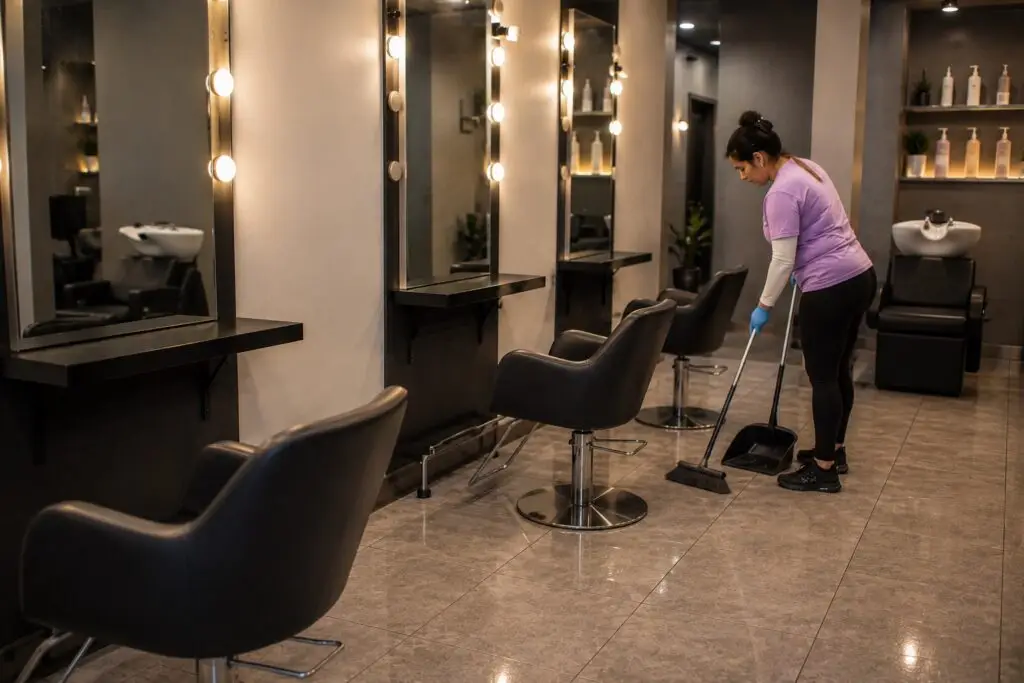
- Floors swept and mopped, including under and around chairs and stations
- Hair sweeping is normally continuous by your staff between clients; the vendor handles the thorough end-of-day reset
- Station surfaces, drawers exterior, and shelving
- Chair bases, pedals, and hydraulics, where hair and product accumulate invisibly
- Mirrors and the frame edges around them
- Trolleys and mobile units
- Shampoo bowls, taps, and the surrounding surfaces
- Under and behind fixed units, on a periodic rather than daily basis
Chair bases and the area beneath shampoo bowls are the two places that separate a genuine salon clean from a superficial one. Hair and product residue collect there steadily, they are invisible from standing height, and they are exactly where a client’s eye lands while reclined at the basin.
Treatment and spa rooms
- Floors, skirting, and corners
- Non-treatment surfaces: counters, shelving, trolleys, and cabinetry exteriors
- Mirrors, glass, and light fixtures
- Waste bins emptied and cleaned
- Doors, frames, and handles
Treatment surfaces, linens, and any implement handling stay with your staff and follow your own protocols. The vendor cleans the room around the practice, not the practice itself. Where that boundary sits should be written into the scope so nobody assumes the other side has it.
Wet areas
Anywhere with standing water and warmth needs disproportionate attention: shampoo areas, pedicure stations, wet rooms, steam rooms, and showers.
- Floors, grout, and edges, where moisture sits
- Drains, which are the usual source of persistent odour
- Splash zones on walls and adjacent cabinetry
- Hard-water buildup on taps and fixtures
- Ventilation covers, since these rooms hold humidity
Note again that pedicure basin disinfection between clients is a regulated protocol for your staff. The vendor cleans the surrounding floor, walls, and fixtures.
Product residue is the thing generic cleaners miss
Salons accumulate a specific kind of grime that ordinary commercial cleaning does not anticipate: hairspray and styling product film on every horizontal and vertical surface near the styling floor, colour splashes on walls, floors, and skirting, wax residue, nail dust settling well beyond the manicure station, and product overspray on mirrors and light fittings.
Hairspray film is the one to watch. It builds gradually into a tacky layer that grabs dust, and once established it needs a specific approach rather than a general-purpose spray. A vendor who has worked in salons will know to look for it on mirror frames, light fittings, and the wall behind stations. One who has not will keep cleaning the same surfaces and wondering why they never look right.
Frequency and scheduling
Daily is the baseline for a salon operating a full appointment book, covering floors, restrooms, reception, mirrors, and waste. Periodic work layers on top: detailed chair and station work, wall and skirting attention, wet-area deep treatment, high dusting and light fittings, and floor treatment appropriate to the surface.
Scheduling is the practical constraint. Salons rarely have a clean closing window, because the last client often overruns and staff stay to reset. The two workable patterns are after the last appointment, accepting that the start time moves, or before opening, which gives a clear building but a tighter window. Either way it needs to flex around the book rather than assume a fixed close.
What to specify when hiring
- The regulated boundary: implements, tools, and pedicure basins stay with licensed staff, in writing
- What your team does daily versus what the vendor does on a visit
- Chair bases, shampoo bowls, and under-unit access, called out explicitly rather than implied by “floors”
- Product residue: hairspray film, colour splashes, and nail dust named directly
- Wet area and drain treatment on a schedule
- Retail display handling: what may be moved and what may not
- Access and timing, with realistic flexibility around an overrunning book
- Products safe around clients, particularly fragrance in a space where people already sit among strong product smells
Salon and spa cleaning across the region
We clean salons, spas, barbershops, and treatment studios throughout Greater Cincinnati and Northern Kentucky, including Covington, Newport, Bellevue, Fort Thomas, Florence, Erlanger, Edgewood, Fort Mitchell, Independence, Cold Spring, Highland Heights, Alexandria, and across Cincinnati.
We schedule around your appointment book rather than a fixed close, and our cleaners are background-checked W-2 employees rather than subcontractors, which matters in a space holding retail stock and client records. We are licensed, bonded, and insured.
We are also clear about the boundary: implement disinfection, tool handling, and pedicure basin protocols stay with your licensed staff under your own compliance obligations. We will write that into the scope rather than leave it ambiguous, because ambiguity there is a licence risk for you and not for us.
See the full scope on our commercial office cleaning page, and our first commercial clean is free with no obligation.
Tired of cleaning after close yourself? Tell us your layout, your services, and when your book realistically finishes, and we will scope the parts that are genuinely ours. Request a free quote or call (859) 750-6618.
Can a cleaning company handle our salon's sanitation requirements?
No, and you should be wary of one that says it can. Disinfecting implements and tools between clients, handling shears and clippers, and pedicure basin protocols are regulated practice tied to your cosmetology licence and belong with your licensed staff. A general cleaning vendor handles everything around that: floors, restrooms, reception, wet areas, glass, dusting, waste, and periodic deep work.
How often should a salon be professionally cleaned?
Daily for a salon running a full book, covering floors, restrooms, reception, mirrors and waste. Periodic work layers on top: detailed chair and station cleaning, wall and skirting attention, wet-area and drain treatment, high dusting and light fittings, and floor treatment suited to the surface.
What do generic cleaning companies typically miss in a salon?
Three things. Hairspray and product film, which builds into a tacky dust-grabbing layer on mirror frames, light fittings and the wall behind stations. Chair bases, pedals and hydraulics, where hair and product collect invisibly from standing height. And under and around shampoo bowls, which is exactly where a reclined client is looking.
Who sweeps hair between clients?
Your staff, continuously through the day, since it happens between every appointment. The vendor handles the thorough end-of-day reset: under and around chairs, chair bases, station surfaces, and the corners and edges that continuous sweeping never quite reaches.
Can you clean around our retail displays?
Yes, and what may be moved should be agreed in writing. Most vendors will dust around displays without rearranging merchandising, since product placement is deliberate and stock is valuable. If you want shelving cleaned underneath, specify who moves the product and how it should be returned.
What about the smell of cleaning products around clients?
Worth raising at quoting stage. Salons already carry strong product smells, and adding heavy cleaning fragrance on top is unpleasant in a space where clients sit for an hour or more. Low-odour or fragrance-free options are available and cost no more; it is simply a matter of specifying it rather than accepting the default.
When can you clean if our last appointment runs late?
Two workable patterns: after the last appointment, accepting a start time that moves with the book, or before opening, which gives a clear building but a tighter window. Salons rarely have a reliable closing time, so the schedule has to flex around that rather than assume a fixed close. Tell us which you prefer and how much your book typically overruns.
Do you clean treatment rooms in a spa?
We clean the room around the practice: floors, skirting, corners, non-treatment surfaces, cabinetry exteriors, mirrors, light fixtures, doors and bins. Treatment surfaces, linens and any implement handling stay with your staff under your own protocols. That boundary goes into the written scope so neither side assumes the other has it.
Related guides
- Commercial Cleaning vs Janitorial Services — routine upkeep versus the deeper periodic work.
- Retail Store Cleaning — relevant if you carry a retail product wall.
- How to Choose a Cleaning Company — the vetting questions that matter most.
A Salon That Looks As Good As Your Work
Get a free, no-obligation quote scoped around your book. No contracts, and your first clean is on us.