Churches, schools, and childcare centres have more in common with each other than any of them has with a standard office. All three involve children, all three carry a duty of care that goes beyond appearance, and all three tend to run on volunteer effort or already-stretched staff who absorb cleaning on top of their actual jobs.
They also share a specific vetting requirement that most commercial buyers never think about: whoever cleans the building will be alone in spaces where children spend their time. This guide covers what each of these environments actually needs, why background checking matters more here than anywhere else, and how to structure cleaning around usage patterns that look nothing like a normal work week.
The vetting question comes first
Before scope, before frequency, before price, establish who will physically be in the building. For any facility serving children, this is not a box-ticking exercise:
- Are cleaners W-2 employees or subcontractors? Subcontracted labour means the company you signed with may not know who is in your building tonight.
- Is every cleaner background checked? Ask who runs the checks and whether it covers everyone who could be assigned.
- Will it be the same crew consistently? Familiar faces matter to staff, parents, and congregations.
- Are you notified when the assigned crew changes?
- Does the vendor understand your own safeguarding policy? Many organisations have rules about adults being alone in the building or in specific rooms, and the cleaning vendor needs to work within them rather than around them.
A vendor who treats these questions as routine and answers them immediately understands the sector. One who finds them unusual does not.
Childcare centres and preschools
The most demanding of the three, because illness moves fast through young children and parents notice everything.
Daily requirements
- Disinfection of all high-touch surfaces at child height, which is lower than adults instinctively clean
- Tables, chairs, and eating surfaces
- Door handles, light switches, cubbies, and gates
- Restrooms and nappy changing areas, cleaned and disinfected thoroughly
- Floors throughout, since floors are effectively furniture for small children
- Sinks, taps, and hand-washing stations
- Trash removal including nappy disposal areas
- Mats, soft flooring, and crawl areas
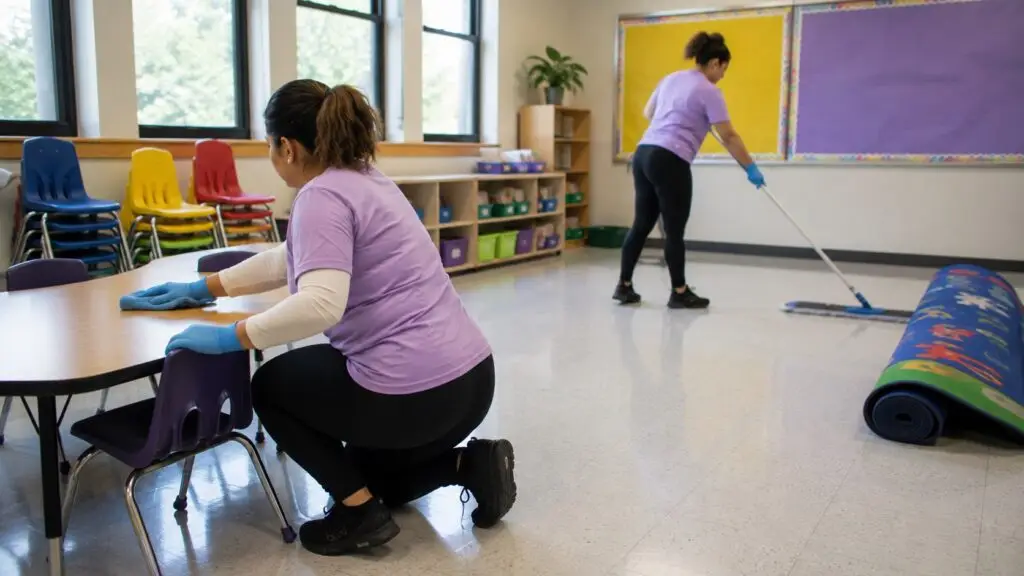
Two things distinguish childcare cleaning from ordinary commercial work. First, cleaning happens at child height, not adult height, which means the bottom two feet of every wall, every table underside, and every low surface matter more than the eye-level surfaces adults notice. Second, product selection is genuinely constrained: products used on surfaces children mouth and touch constantly need to be appropriate for the setting and used strictly according to label directions, including any rinse requirements.
Toys and soft furnishings are usually a staff responsibility rather than a vendor one, because they follow the centre’s own procedures and rotation schedules. Agree that boundary explicitly.
Schools
Schools are high-volume, high-touch environments with pronounced peaks and long quiet periods.
- Classrooms: desks, chairs, shared equipment, door hardware, floors
- Restrooms: the highest-frequency need in any school, often requiring attention during the day rather than only after hours
- Cafeterias and dining areas: tables, floors, and serving surrounds, with food debris driving both hygiene and pest considerations
- Gyms and activity spaces: floors, equipment touchpoints, changing areas
- Corridors and stairwells: floors, handrails, lockers
- Offices, staff rooms, and libraries
The rhythm matters as much as the scope. Term time needs daily service with heightened attention during illness season, typically late autumn through winter in this region. Holidays and summer are when deep work becomes possible: floor stripping and refinishing, carpet extraction, high dusting, vents, and the detailed work that simply cannot happen with students in the building. Schools that do not plan and book that summer work in advance usually find they have run out of time.
Churches and places of worship
Churches have the most unusual usage pattern of the three: one very heavy day, scattered midweek activity, and periodic large events.
- Sanctuary and worship space: pews or seating, floors, entry areas, and the surfaces visible from every seat
- Restrooms: heavy concentrated use on service days, light use otherwise
- Fellowship halls and kitchens: used for meals, events, and community groups, often by volunteers with variable standards
- Nursery and children’s ministry areas: effectively childcare spaces and deserving childcare standards, which is the area most often under-served
- Classrooms and meeting rooms
- Entryways and lobbies, which carry the first impression for visitors
The practical structure that works for most congregations is a main clean after the heaviest service day, a lighter midweek visit if there is regular activity, and event-based cleaning around larger gatherings. Weddings, funerals, holiday services, and community events all need their own arrangements rather than being absorbed into a routine schedule.
Children’s ministry areas deserve particular attention. They are used intensively for a few hours a week by young children, often cleaned by volunteers afterward, and they usually need the same standard as a childcare centre rather than the standard applied to the rest of the building.
The volunteer problem
Most churches and many small schools have relied on volunteers or staff to clean, and it works until it does not. The failure pattern is consistent: a small group carries it, they burn out, standards become inconsistent, and the areas needing the most care are the ones most likely to be skipped because they are the least pleasant.
The honest calculation is not volunteer effort against a cleaning invoice. It is what those people would otherwise be doing, what the inconsistency costs in how the building is perceived, and whether anyone has checked that the people cleaning the nursery meet the same standard your safeguarding policy applies to everyone else in that room.
Many organisations land on a sensible middle: volunteers or staff handle daily tidying and light upkeep, and a professional vendor handles restrooms, floors, disinfection, and periodic deep work. That is usually the best value and it removes the least pleasant tasks from people who are giving their time.
Illness season
Any facility with children should plan for a seasonal increase rather than reacting to an outbreak. From roughly late autumn through winter, high-touch surface disinfection frequency should rise, restroom attention should increase, and hand-washing stations need reliable stocking.
One point worth being clear about: disinfection only works on surfaces that have been cleaned first, and the product has to remain wet for the contact time stated on its label. Spraying and immediately wiping does not disinfect. Any vendor working in a childcare or school setting should be able to explain both without prompting.
Scheduling around the building
None of these facilities runs a nine to five pattern, so scheduling needs actual thought:
- Childcare: after the last child leaves, often early evening rather than late night
- Schools: after the school day, with a daytime restroom presence in larger buildings, plus deep work in holidays
- Churches: built around the main service day, with event cleaning arranged separately
Access and keys need settling in advance in every case, and for buildings serving children, everyone with access should be background checked without exception.
Cleaning community buildings across the region
We clean churches, schools, childcare centres, and community facilities throughout Northern Kentucky and Greater Cincinnati, including Covington, Newport, Fort Thomas, Bellevue, Highland Heights, Cold Spring, Alexandria, Florence, Erlanger, Edgewood, Fort Mitchell, Independence, and across Cincinnati.
Our cleaners are W-2 employees rather than subcontractors, every one is background checked, and we tell you when your assigned crew changes. We are licensed, bonded, and insured, we work within your own safeguarding policies rather than around them, and we do not require long-term contracts. We are also happy to structure around volunteer effort rather than replacing it, taking the restrooms, floors, and disinfection while your people keep doing what they do best.
You can see the full scope on our commercial office cleaning page, and our first commercial clean is free with no obligation.
Stretching volunteers thin, or worried about the nursery? Tell us about your building and your usage pattern and we will scope something that fits both, including what we would leave to your own people. Request a free quote or call (859) 750-6618.
Are your cleaners background checked for facilities with children?
Yes. Every cleaner is a background-checked W-2 employee rather than a subcontractor, which means the company you hire knows exactly who is in your building. We also tell you when your assigned crew changes. For churches, schools, and childcare centres this should be the first question you ask any vendor, and a vendor who finds the question unusual is telling you something.
How often should a daycare or preschool be cleaned?
Daily, with disinfection of high-touch surfaces at child height every single operating day. Illness moves quickly through young children, and the surfaces that matter most are lower than adults instinctively clean: table undersides, the bottom of walls, cubbies, gates, and floors. Frequency typically increases further during illness season from late autumn through winter.
Do you clean toys and soft furnishings in childcare settings?
Usually not, and that is deliberate. Toy cleaning and rotation normally follow the centre’s own procedures and schedules, and it works best staying with staff who know those procedures. We handle surfaces, floors, restrooms, changing areas, and touchpoints. The boundary should be written into the scope explicitly so nothing falls between the two.
How should church cleaning be scheduled?
Around your usage rather than on a flat weekly rhythm. Most congregations do well with a main clean after the heaviest service day, a lighter midweek visit if there is regular activity, and separate arrangements for larger events such as weddings, funerals, and holiday services. Trying to absorb big events into a routine schedule is where most church cleaning arrangements break down.
When should schools schedule deep cleaning?
During holidays and summer, and it should be booked well in advance. Floor stripping and refinishing, carpet extraction, high dusting, and vent cleaning genuinely cannot happen with students in the building. Term time needs daily service with heightened attention through illness season. Schools that leave summer deep work unbooked usually discover the window has closed.
Should we replace our volunteers with a cleaning company?
Not necessarily, and a blended approach often works best. Volunteers and staff handle daily tidying and light upkeep, while a professional vendor takes restrooms, floors, disinfection, and periodic deep work. That removes the least pleasant tasks from people giving their time, keeps standards consistent in the areas that matter most, and usually costs less than full service.
What cleaning products are safe around children?
What matters is that products are appropriate for the setting and used strictly according to their label, including dilution and any rinse requirements for surfaces children touch or mouth. Disinfection also only works on a surface that has been cleaned first, with the product left wet for the contact time on the label. Ask any vendor to explain both, because in a childcare setting they should not need prompting.
Do church nursery areas need special attention?
Yes, and this is the most commonly under-served area in a church building. Nursery and children’s ministry spaces are used intensively by young children for a few hours a week, often cleaned by volunteers afterward, and they warrant the same standard as a childcare centre rather than the standard applied to the rest of the building. Anyone cleaning them should meet the same vetting requirement as anyone else working with children in your organisation.
Related guides
- Commercial Cleaning vs Janitorial Services — the difference between routine upkeep and periodic deep work.
- How to Choose a Cleaning Company — the vetting questions, which matter most in buildings serving children.
- Office Cleaning Services: What’s Actually Included — useful for church offices and school admin areas.
Cleaning You Can Trust Around Children
Background-checked employees, no subcontractors, no long-term contracts. Your first clean is on us.