“Office cleaning” is one of those phrases everyone assumes they understand until two people compare what they are actually paying for. One company’s office cleaning is trash, vacuuming, and restrooms. Another’s includes interior glass, high dusting, and appliance interiors. The word is identical. The scope is not, and the gap between them is where nearly every complaint about a cleaning vendor begins.
This guide lays out what professional office cleaning normally includes, area by area, what it usually does not include, how often each task should realistically happen, and how to read a scope document before you sign it. If you manage an office in Cincinnati or Northern Kentucky and you are either hiring for the first time or quietly unhappy with your current provider, this is the detail you need.
The short answer
Routine office cleaning, the core of any commercial office cleaning service, covers the recurring upkeep of a working workspace: trash and recycling, restrooms, floors, break areas, shared touchpoints, and the visible surfaces people interact with daily. It is built for consistency, not depth.
Deeper work such as interior windows, vents, high dusting, light fixtures, baseboards, carpet extraction, and appliance interiors is normally scoped separately, either as a periodic add-on or as a scheduled deep clean a couple of times a year. Assuming those are included in a routine rate is the single most common source of disappointment.
The standard office cleaning scope, area by area
Open floor and workstations
- Empty all trash and recycling, replace liners
- Vacuum carpeted areas, with attention to traffic lanes and under-desk zones where reachable
- Sweep and mop hard floors
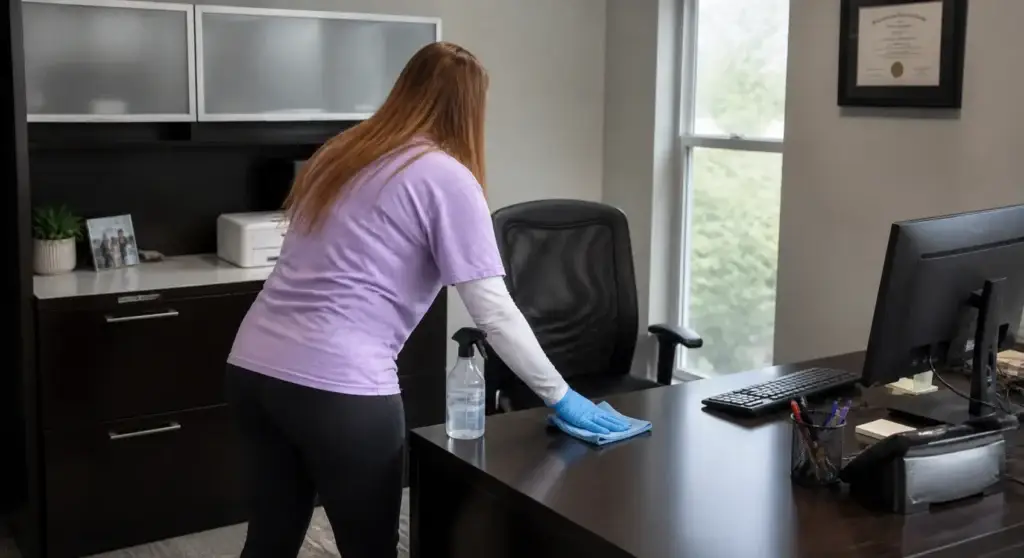
- Dust accessible surfaces: desk edges, filing cabinets, shelving, window sills, monitor stands
- Spot-clean partition glass and cubicle panels
- Disinfect shared touchpoints: shared phones, copier and printer panels, shared desk surfaces
A note on desks: most vendors will not move or clean around personal items, papers, keyboards, or anything on an occupied desk, and you do not want them to. If you want desks wiped, the standard practice is a clear-desk expectation for staff on cleaning nights.
Private offices
- Trash emptied and liners replaced
- Floors vacuumed or mopped
- Accessible surface dusting
- Interior glass and door handles spot-cleaned
Conference and meeting rooms
- Table wiped and sanitized
- Chairs straightened, upholstery vacuumed as needed
- Whiteboards cleaned on request (worth specifying, since some offices want notes preserved)
- Floors cleaned
- Trash emptied
- Glass walls and doors spot-cleaned
Conference rooms are the highest-visibility space in most offices because clients sit in them. If you cut frequency anywhere, do not cut it here.
Reception and entryway
- Entry glass and door handles cleaned
- Reception desk and counter wiped
- Waiting area seating tidied and vacuumed
- Entry mats vacuumed or shaken out
- Floors cleaned, with extra attention in winter when salt and slush come in
Break room and kitchen
- Counters, sink, and faucet cleaned and sanitized
- Tables and chairs wiped
- Appliance exteriors wiped: refrigerator, microwave, dishwasher, coffee equipment
- Microwave interior (commonly included, but confirm it)
- Trash and recycling emptied, liners replaced
- Floors swept and mopped
Refrigerator interiors are almost never part of routine service. Most offices handle this with a scheduled purge day rather than paying a vendor to arbitrate whose lunch is whose.
Restrooms
- Toilets and urinals cleaned and disinfected, inside and out, including the base and behind
- Sinks, counters, and fixtures cleaned and polished
- Mirrors cleaned
- Partitions and door handles disinfected
- Floors swept, mopped, and disinfected, with attention to edges and corners
- Restock soap, paper towels, and tissue (confirm who supplies these)
- Trash emptied and sanitary bins serviced
Restrooms are the reliable early indicator. When a cleaning program starts slipping, restrooms show it first and staff notice within days.
Corridors, stairwells, and shared space
- Floors vacuumed or mopped
- Handrails disinfected
- Elevator interiors and buttons cleaned
- Interior glass spot-cleaned
- Drinking fountains cleaned and disinfected
What routine office cleaning usually does not include
These are legitimate services. They are simply not part of a standard recurring scope, and they should be priced and scheduled on their own:
- Interior window and full glass cleaning beyond spot work
- Exterior windows, which require different equipment and different liability coverage
- High dusting: vents, ductwork exteriors, ceiling corners, light fixtures, sprinkler heads
- Baseboards and detailed trim work
- Carpet extraction and upholstery cleaning
- Hard floor stripping, waxing, buffing, and refinishing
- Appliance interiors beyond the microwave
- Inside cabinets, drawers, and storage
- Wall washing beyond spot-cleaning marks
- Post-construction and post-renovation cleanup
- Server rooms and secured areas, which usually need separate access arrangements
If a quote seems noticeably cheaper than the others, the difference is almost always sitting somewhere in this list.
How often each task should happen
A well-built office cleaning program does not do everything every visit. It layers frequencies:
- Every visit: trash, restrooms, break room surfaces, floors in high-traffic areas, entry glass, shared touchpoints
- Weekly: full vacuuming including low-traffic areas, detailed dusting, interior glass and partitions, conference room detail
- Monthly: vents and returns, high dusting, baseboards, door frames, light switch plates, chair bases and casters
- Quarterly or twice yearly: carpet extraction, upholstery cleaning, hard floor maintenance, light fixture cleaning, full interior windows
When a scope document lists tasks without frequencies, that is not a scope document. It is a sales sheet.
What changes by office type
Professional and corporate offices
Fairly predictable. The drivers are headcount, client traffic, and whether staff eat at their desks. Hybrid schedules have changed this significantly: many offices now have heavy Tuesday through Thursday occupancy and near-empty Mondays and Fridays, and cleaning schedules should follow occupancy rather than habit.
Medical and dental practices
Higher standards, tighter protocols, and clear boundaries. General cleaning staff handle waiting areas, restrooms, offices, and common space. Clinical areas, regulated waste, and anything involving contaminated materials follow separate protocols and stay with trained clinical staff. Any vendor that blurs this line is a liability.
Client-facing spaces: salons, studios, and showrooms
Appearance carries commercial weight, so glass, floors, and restrooms need higher frequency than headcount alone would suggest. Timing usually has to work around appointments rather than a standard close.
Warehouses and light industrial with attached offices
Effectively two scopes in one building. The office side follows a normal program while the warehouse side needs different equipment, different floor care, and a realistic view of what can be cleaned around active operations.
After-hours or during business hours?
Most offices are better served after hours. Vacuums are loud, floors need time to dry, and nobody wants a cleaning cart rolling past a client meeting. After-hours work also means the space is ready at the start of the day rather than mid-afternoon.
During-hours service makes sense in a few cases: buildings that cannot grant after-hours access, high-traffic facilities that need restroom and common-area touch-ups through the day, and secured environments where escorted access is required. A common structure is a light daytime presence for restrooms and common areas plus a full after-hours clean.
The practical consideration is access. Keys, fobs, alarm codes, and after-hours building policies need to be sorted before the first visit, and whoever holds that access should be background checked.
What a good scope document looks like
Before you sign, you should have a written document that specifies:
- Every area covered, named specifically rather than as “common areas”
- Every task per area, with the frequency attached to each one
- What is explicitly excluded, so nobody is guessing later
- Who supplies consumables: soap, paper towels, tissue, liners
- Service days and time window
- Access arrangements and who holds keys or codes
- Your single point of contact, and theirs
- What happens when something is missed, with a response window
- Term and cancellation, including whether it auto-renews
If a vendor will not put the scope in writing at this level of detail, you have learned something useful before spending any money.
Signs your office cleaning is not working
- Restrooms are the first thing anyone mentions
- You see different faces in the building every week, which usually means subcontracting or high turnover
- Corners, edges, and behind doors are visibly untouched while the middle of the room looks fine
- Entry glass is smudged at handle height
- Break room appliance exteriors are sticky
- You are quietly buying your own paper products despite a contract that says otherwise
- Nobody can find the written scope
Most of these are frequency or accountability problems rather than effort problems. Raise them once, specifically, in writing. If nothing changes, the issue is structural.
Getting an accurate quote
To quote an office properly, a vendor needs to know approximate square footage, the number of restrooms and fixtures, headcount and typical occupancy pattern, floor surface mix, how many private offices and conference rooms, whether there is a break room or full kitchen, your preferred service days and hours, and any access constraints.
A vendor who quotes an office sight unseen, from square footage alone, is guessing. A walkthrough takes twenty minutes and is the difference between a quote that holds and a quote that gets revised after month one.
Office cleaning across Cincinnati and Northern Kentucky
We clean offices and workspaces throughout Greater Cincinnati and Northern Kentucky, including Covington, Newport, Fort Thomas, Florence, Erlanger, Edgewood, Fort Mitchell, Independence, Cold Spring, Highland Heights, Alexandria, Burlington, Union, Bellevue, and across Cincinnati proper. Our cleaners are W-2 employees rather than subcontractors, every one is background checked, and we are licensed, bonded, and insured. We schedule around your business hours and we do not require long-term contracts.
If you want to evaluate the work rather than the pitch, our first commercial clean is free with no obligation. You can also review the full scope on our commercial office cleaning page or read what clients say.
Want a scope built around your actual office? We will walk the space, put every task and frequency in writing, and tell you honestly where you can spend less. Request a free office cleaning quote or call (859) 750-6618.
What is included in standard office cleaning?
A standard recurring scope covers trash and recycling, restroom cleaning and restocking, floor care in occupied areas, break room surfaces and appliance exteriors, accessible surface dusting, interior glass spot-cleaning, and disinfection of shared touchpoints such as door handles, light switches, and shared equipment. Deeper items like vents, high dusting, baseboards, carpet extraction, and interior windows are normally scoped separately.
Do office cleaners clean individual desks?
Generally they clean around desks rather than on them. Most vendors will not move personal items, papers, or keyboards, both to avoid disturbing work and to avoid liability for anything damaged or misplaced. If you want desk surfaces wiped, the usual arrangement is a clear-desk expectation for staff on cleaning nights, which you should state in the scope.
Should our office be cleaned during or after business hours?
After hours suits most offices. Vacuuming is disruptive, floors need drying time, and the space is ready at the start of the day rather than mid-afternoon. Daytime service makes sense when the building cannot grant after-hours access, when high traffic means restrooms need midday attention, or when secured areas require escorted access. Many offices combine a light daytime touch-up with a full after-hours clean.
How often should an office be cleaned?
Headcount, client traffic, and shared restrooms are the main drivers. A small professional office with light traffic often works well on weekly or twice-weekly service. Higher headcount, public-facing traffic, or heavily used shared restrooms usually justify three nights a week or nightly. Since hybrid schedules concentrate occupancy midweek in many offices, it is worth matching the schedule to actual occupancy rather than to a five-day habit.
Are interior windows included in office cleaning?
Spot-cleaning of entry glass, partition glass, and door glass is typically included in routine service. Full interior window cleaning is usually a separate scheduled service, commonly quarterly or twice a year. Exterior windows are a different service entirely, requiring specialized equipment and different liability coverage, and are generally handled by a window-cleaning specialist.
Who provides soap, paper towels, and toilet paper?
It depends on the agreement, which is exactly why it should be written down. Some office cleaning contracts include consumables in the rate, some bill them separately at cost, and some leave stocking to the client. This is a real cost difference, so confirm it before comparing two quotes, because the cheaper quote may simply have excluded it.
Is office cleaning the same as janitorial service?
They overlap heavily. Janitorial is the broader term for recurring building upkeep across any commercial facility, while office cleaning describes that same recurring work applied specifically to workspace environments. Practically, if you are hiring for an office, the two terms will describe nearly the same scope. The distinction that matters is routine upkeep versus periodic deep cleaning.
Do you need a contract for office cleaning?
Not with every provider. Long agreements with automatic renewal are common in the industry but far from universal, and we do not require them. Before signing anything, ask specifically whether month-to-month is available, how much notice cancellation requires, and whether the agreement renews automatically if you do nothing.
How do you handle keys, alarm codes, and after-hours access?
Access should be settled in writing before the first visit, covering who holds keys or fobs, who knows the alarm code, and what the procedure is if an alarm trips. Anyone with access to your building after hours should be background checked, and you should be told when the assigned crew changes. If a vendor is casual about this, treat it as a warning sign.
Can you clean medical and dental offices?
Yes, for the general areas: waiting rooms, reception, restrooms, private offices, break rooms, corridors, and common space, with the higher-frequency disinfection those environments need. Clinical treatment areas, regulated medical waste, and anything involving contaminated materials follow separate protocols and remain with trained clinical staff. Any cleaning vendor that offers to blur that boundary should be avoided.
What if something gets missed?
Your agreement should name a response window and a single point of contact on both sides. Ours is a 24-hour satisfaction guarantee: tell us what was missed and we return to correct it. What matters more than the specific promise is that it is written down, that one named person owns it, and that you are not chasing a general inbox.
Related guides
- Commercial Cleaning vs Janitorial Services — the difference between routine upkeep and periodic deep work, and which your business needs.
- How Often Should You Have Your Office Cleaned? — what actually drives frequency.
- How to Choose an Office Cleaning Company — the questions worth asking before you sign.
Ready for a Cleaner Office?
Get a free, no-obligation office cleaning quote. No contracts, and your first clean is on us.