Medical and dental practices sit in an awkward spot when hiring a cleaning company. General office cleaners often oversell what they can handle in a healthcare setting, and specialist healthcare cleaning contractors are frequently scaled for hospitals rather than a four-operatory dental practice or a small family clinic.
The useful thing to understand is that cleaning a medical office splits cleanly into two categories, and the split is not negotiable. This guide covers where that line sits, what a general cleaning vendor should and should not be doing in your practice, what a realistic scope looks like, and the questions worth asking before you hire. It is written for practice managers in Cincinnati and Northern Kentucky.
The line that matters
Every medical or dental practice has two distinct cleaning domains:
- General areas. Waiting rooms, reception, restrooms, private offices, corridors, break rooms, staff areas, and administrative space. These are cleaned to a higher standard than a typical office because of patient volume and turnover, but they are within the scope of a well-trained general commercial cleaning vendor.
- Clinical areas. Treatment rooms, operatories, procedure spaces, anything involving regulated medical waste, sharps, contaminated instruments, or blood and bodily fluids. These follow protocols owned by trained clinical staff under your practice’s infection control program.
A general cleaning vendor should be entirely clear about which side of that line they work on. If a cleaning company offers to handle your clinical decontamination, regulated waste, or instrument areas, that is a reason to stop the conversation rather than a selling point. Those responsibilities carry regulatory weight and belong with staff trained and accountable under your own compliance program.
What a general scope should cover
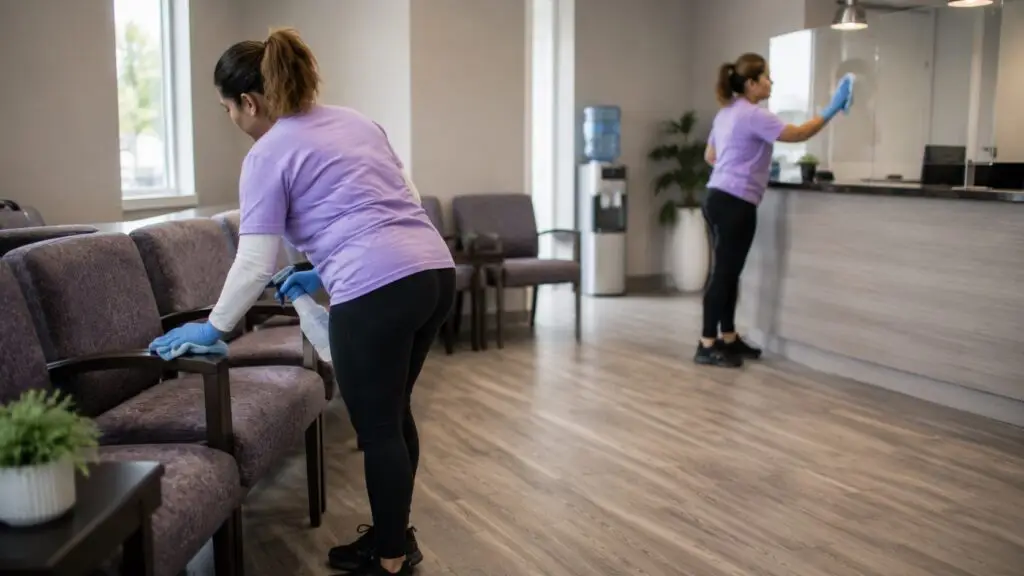
Waiting room and reception
- All seating cleaned and disinfected, including arms and backs where patients grip
- Side tables, magazine racks, and children’s areas
- Reception counter, sign-in surfaces, shared pens, and payment terminals
- Door handles, push plates, and interior glass at hand height
- Floors cleaned appropriate to surface
- Trash emptied
- Water stations and coffee areas if present
Waiting rooms are the highest-turnover space in the building, and the first thing a professional commercial cleaning service should plan around. People sit, touch, cough, and leave, and the next patient arrives minutes later. Frequency here should not be economised.
Restrooms
- Full cleaning and disinfection of all fixtures, inside and out
- Floors including edges, corners, and behind fixtures
- Dispensers restocked and wiped
- Touchpoints disinfected: handles, latches, flush controls, faucets
- Mirrors and counters
- Trash and sanitary bins serviced
Patient-accessible restrooms in a healthcare setting are held to a higher standard than in an office, and patients notice them more because they are already thinking about hygiene.
Corridors, offices, and staff areas
- Floors, handrails, and door hardware
- Private office cleaning and trash
- Break room surfaces, sink, appliance exteriors, tables
- Staff restrooms to the same standard as patient restrooms
General areas within clinical zones
In many practices, a cleaning vendor handles floors and non-clinical surfaces in treatment areas after clinical staff have completed their own decontamination protocol. Where that boundary sits should be written into the scope explicitly, agreed with whoever owns infection control at your practice, and sequenced so the two never overlap.
Frequency
Daily service is the baseline for general areas in a practice seeing patients five days a week, not an upgrade. Waiting rooms, restrooms, and high-touch surfaces need attention every single day the practice operates.
Practices with high patient volume, paediatric patients, or extended hours often need more: a midday restroom and waiting room touch-up in addition to the full after-hours clean. Paediatric practices in particular tend to justify this, because the waiting room is a genuinely different environment by two in the afternoon.
Disinfection done properly
Disinfection matters more here than in a standard office, which makes it worth knowing what correct practice looks like:
- Surfaces are cleaned before they are disinfected. Disinfectant applied over soil binds to the soil rather than reaching the surface. This step is not optional.
- Contact time is respected. Every disinfectant has a required dwell time on its label, and the surface must remain visibly wet for that period. Spraying and immediately wiping dry does not disinfect.
- Products suit the surface. Some disinfectants damage equipment finishes, upholstery, or electronics over time.
- Touchpoints are treated as a defined list rather than left to judgement.
Ask any vendor what product they use and what its contact time is. A vendor working in healthcare settings should answer both without hesitating.
Scheduling around a practice
Most practices are cleaned after the last patient leaves. The considerations that come up:
- Access and keys. Anyone entering after hours should be background checked, and you should be told when the assigned crew changes.
- Patient privacy. Cleaning staff will be in a building containing protected health information. Charts, screens, and paperwork should be secured before the crew arrives, and your vendor should train staff not to handle documents. Ask whether they will sign a confidentiality agreement.
- Equipment. A clear list of what must not be touched, moved, or cleaned by the cleaning crew prevents expensive misunderstandings.
- Sequencing. Clinical decontamination happens before general cleaning, never simultaneously.
What to ask before hiring
- Do you work in medical or dental practices currently? Experience in the setting matters more than a generic claim.
- What exactly will you not do? A vendor with clear boundaries understands the environment. One who says “anything you need” does not.
- Are your staff background checked, and are they employees or subcontractors? Turnover in a practice with confidential information is a real concern.
- Will you sign a confidentiality agreement?
- What disinfectant do you use and what is its contact time?
- Will it be the same crew each visit? Consistency matters more here because the environment has more rules.
- Are you licensed, bonded, and insured, and can I have the certificate?
- How do you handle scope changes if we add operatories or extend hours?
Warning signs in a healthcare context
- Offering to handle regulated medical waste, sharps, or clinical decontamination
- Vagueness about where their responsibility ends and clinical staff’s begins
- No clear answer on disinfectant products or contact times
- Reluctance to sign a confidentiality agreement
- Subcontracted crews with no consistent staffing
- Selling whole-building disinfection or fogging as a substitute for daily cleaning rather than a supplement to it
How we work with practices
We clean general areas for medical, dental, and professional healthcare practices across Greater Cincinnati and Northern Kentucky: waiting rooms, reception, restrooms, corridors, private offices, break rooms, and staff areas, at the frequency those environments actually require. We clean surfaces before disinfecting them, and we treat high-touch surfaces as a defined list rather than a general intention.
We are equally clear about what we do not do. Clinical treatment protocols, regulated medical waste, sharps, and contaminated instrument handling stay with your trained clinical staff under your own infection control program. We will happily write that boundary into the scope so there is no ambiguity for either side.
Our cleaners are background-checked W-2 employees rather than subcontractors, we are licensed, bonded, and insured, and we do not require long-term contracts. You can see our full scope on the commercial office cleaning page, and our first commercial clean is free with no obligation.
Managing a practice and comparing vendors? Tell us your patient volume, your hours, and where you want the boundary drawn, and we will put the whole scope in writing. Request a free quote or call (859) 750-6618.
Can a regular commercial cleaning company clean a medical office?
For general areas, yes: waiting rooms, reception, restrooms, corridors, private offices, and break rooms, cleaned at a higher frequency and standard than a typical office. Clinical treatment areas, regulated medical waste, sharps, and contaminated instrument handling are a different matter entirely and belong with trained clinical staff under your practice’s infection control program. A vendor who understands that distinction is the one you want.
What should a cleaning company NOT do in a medical practice?
They should not handle regulated medical waste or sharps, perform clinical decontamination of treatment surfaces or instruments, or work in operatories in a way that overlaps with clinical protocols. If a cleaning vendor offers to take any of that on, treat it as a warning rather than a convenience. Those responsibilities carry regulatory weight and accountability that belongs inside your practice.
How often should a medical or dental office be cleaned?
Daily for general areas whenever the practice is seeing patients, as a baseline rather than an upgrade. Waiting rooms, restrooms, and high-touch surfaces need attention every operating day. Practices with high patient volume, paediatric patients, or extended hours often add a midday restroom and waiting room touch-up on top of the full after-hours clean.
How do you protect patient privacy during cleaning?
Cleaning staff should be trained not to handle charts, paperwork, or screens, and your practice should secure protected health information before the crew arrives. Ask whether the vendor will sign a confidentiality agreement, whether staff are background checked, and whether they are employees rather than subcontractors. Consistent crews matter here because familiarity with the rules reduces mistakes.
What disinfectant should be used in a medical office?
Rather than a specific brand, what matters is process: the surface is cleaned before disinfectant is applied, the product is appropriate for that surface, and the required contact time on the label is actually respected so the surface stays visibly wet for the full period. Ask any vendor what they use and what its contact time is. In a healthcare setting they should answer both immediately.
Do you clean treatment rooms and operatories?
We clean floors and non-clinical surfaces in those spaces after your clinical staff have completed their own decontamination protocol, and only where that boundary has been agreed and written into the scope. The sequencing matters: clinical decontamination first, general cleaning second, never overlapping. We do not perform clinical decontamination itself.
Should waiting room chairs be disinfected daily?
Yes, including arms and backs where patients grip them. The waiting room is the highest-turnover space in a practice, with people sitting, touching surfaces, and leaving minutes before the next patient arrives. Upholstered seating needs products suited to the fabric, so this is worth specifying rather than assuming, since the wrong product degrades upholstery over time.
Is fogging or electrostatic spraying worth it for a practice?
As a supplement, sometimes. As a substitute for daily cleaning, no. Electrostatic sprayers cover complex surfaces evenly and efficiently, which is genuinely useful, but applying disinfectant over an uncleaned surface produces poor results regardless of the equipment. Be sceptical of anyone selling it as a standalone service without a cleaning step in front of it.
Related guides
- Commercial Cleaning vs Janitorial Services — the difference between recurring upkeep and periodic deep work.
- Office Cleaning Services: What’s Actually Included — the baseline scope your general areas should be getting.
- How to Choose a Cleaning Company — vetting questions, insurance, and confidentiality.
Cleaning Built Around Your Practice
Get a free, no-obligation quote with the scope and boundaries in writing. No contracts, and your first clean is on us.