Restaurant cleaning is the most misunderstood category in commercial cleaning, because three different groups are responsible for different parts of it and the boundaries are rarely written down anywhere. Kitchen staff handle a large share. A commercial cleaning company handles another. Licensed specialists handle a third. When a restaurant has a cleanliness problem, it is usually sitting in the gap between two of them.
This guide sets out who does what, what a commercial cleaning scope should actually cover in a food service setting, what genuinely requires a specialist, and how to keep a kitchen inspection-ready. It is written for restaurant owners and managers in Cincinnati and Northern Kentucky.
Who is responsible for what
Getting this straight prevents most problems:
- Your kitchen staff handle daily line cleaning, food-contact surface sanitizing, equipment breakdown and cleaning, dish areas, and closing procedures. This is operational and it stays in house because it is tied to food safety practice and to your own procedures.
- A commercial cleaning company handles the deeper and broader work: front of house, restrooms, floors throughout including under and behind equipment, walls, ceilings where reachable, non-food-contact surfaces, and periodic detail that closing shifts never get to.
- Licensed specialists handle exhaust hood and duct cleaning, grease trap and interceptor servicing, and fire suppression system maintenance. These are regulated, certificated services and they are not part of a general commercial cleaning scope.
That third category matters. Exhaust hood and duct cleaning in particular is governed by fire code and requires certified providers who document the work. Any general cleaning company offering to clean your hood system should be declined, because your insurer and your fire inspector both care who did it and whether it was certified.
Front of house
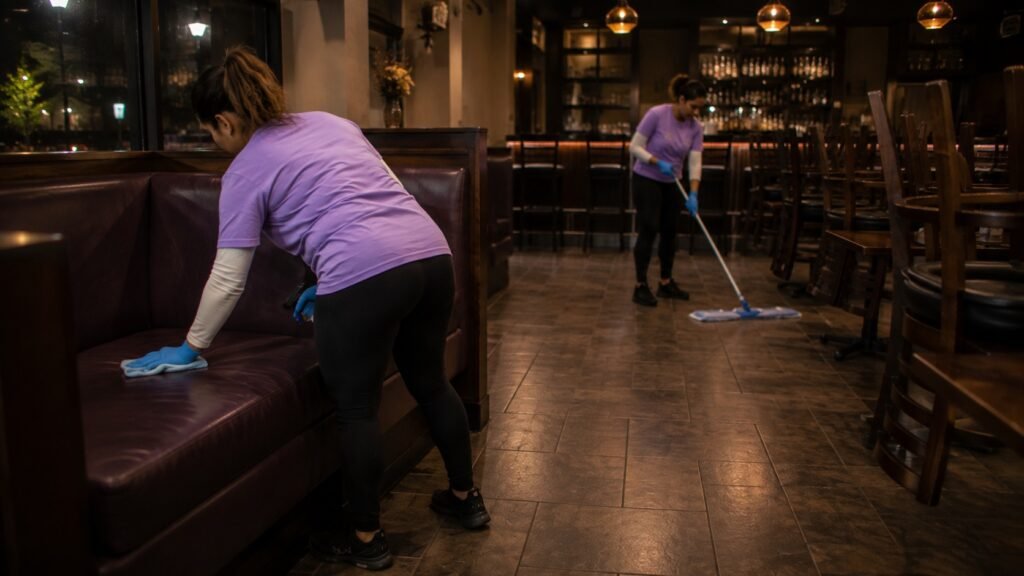
This is where a commercial cleaning company earns its place, because it is the part customers judge and the part closing staff are least able to do properly at midnight.
- Floors: swept, mopped, and detailed at edges, corners, and under fixed seating
- Tables, chairs, booths, and banquettes, including the seams and undersides where food collects
- Bar surfaces, bar front, rails, and speed wells’ surrounding areas
- Entry glass, doors, and windows at hand height
- Host stand, waiting area, and any menus or shared surfaces
- Interior glass, mirrors, and partition surfaces
- Light fixtures, ledges, and decor within reach
- Booth seams and upholstery, which is where crumbs and grease build invisibly
- Trash and recycling
Booth seams and the undersides of tables are the two areas that separate a real restaurant clean from a superficial one. Both are invisible standing up and obvious to a seated customer running a hand along the edge.
Restrooms
Restaurant restrooms carry outsized weight because customers draw a direct line from restroom condition to kitchen condition, fairly or not. They need daily deep attention rather than a wipe:
- All fixtures cleaned and disinfected inside, outside, base, and behind
- Floors including edges, corners, and behind the toilet, where odour originates
- Walls and partitions spot-cleaned, with attention at hand height
- Mirrors, counters, and dispensers
- Touchpoints disinfected: handles, latches, faucets, dispensers
- Full restocking
- Drains treated as needed, since restroom odour is frequently a drain issue rather than a surface one
High-volume restaurants should be checking restrooms hourly during service. That is a staff task, not a vendor one, but it needs to be somebody’s named job.
Back of house
A commercial cleaner supplements rather than replaces kitchen staff here:
- Floors including under and behind equipment where it can be safely accessed
- Floor drains, which are a common source of odour and pest activity
- Walls and splash zones, particularly behind cooking lines
- Ceiling tiles and vents where reachable and where grease accumulates
- Equipment exteriors, legs, and casters
- Shelving, racks, and storage areas
- Walk-in cooler and freezer floors and exteriors, coordinated around stock
- Dry storage, including under and behind shelving
- Dish area surrounds, which take heavy splash and are rarely detailed
- Staff areas, lockers, and break spaces
Floor drains and the wall behind the line are the two back-of-house areas most likely to cause an inspection problem and least likely to get done during a closing shift.
Grease and floors
Restaurant floors are a different problem from other commercial floors because grease changes everything. It carries into front of house on shoes, builds in grout lines, and creates a genuine slip hazard that is both a safety and a liability matter.
Quarry tile and textured non-slip flooring, standard in commercial kitchens, are designed for traction, which means they hold grease in the texture and need deep periodic treatment rather than mopping alone. Mopping with the wrong product can actually make things worse over time by leaving residue that holds more grease.
A realistic program includes daily mopping by staff, periodic deep floor and grout treatment by a commercial vendor, and attention to the transition zones between kitchen and dining room where grease migrates.
Inspection readiness
Health inspections are unannounced, so readiness is a standing condition rather than a preparation task. The areas that commonly generate findings and that a commercial cleaning program can address:
- Floor and wall junctions, and behind and under equipment
- Floor drains and their surrounds
- Ceiling vents and tiles above food areas
- Shelving and storage undersides
- Walk-in floors and door seals
- Grease accumulation on non-cooking surfaces
- Restroom condition generally
- Any evidence of pest activity, which is usually a sanitation-in-hidden-places problem
The pattern is consistent: inspectors look where closing shifts do not. A commercial cleaning program should be scoped around exactly those places.
Scheduling
Restaurant cleaning happens after close or before open, and both have tradeoffs. After close means working late into the night with staff possibly still finishing, and the space is ready for the morning. Before open gives a clear building but a tight window if anything overruns.
Practical points to settle up front: who locks up and who holds keys, whether alarm codes are needed, what happens with deliveries arriving early, whether the crew can access walk-ins and how stock should be handled, and which equipment must not be touched, moved, or cleaned by the cleaning crew. That last one prevents expensive accidents around specialised equipment.
What to specify when hiring
- The exact boundary between kitchen staff tasks and vendor tasks, in writing
- Which equipment may be moved, and by whom
- Floor surface types by zone, since a restaurant typically has three or four
- Deep floor and grout frequency, called out separately from daily mopping
- Walk-in access and how stock is handled
- What is excluded, especially hood systems and grease traps, so nobody assumes coverage that does not exist
- Restroom frequency, and who checks them during service
Food service cleaning across the region
We provide commercial cleaning for restaurants, cafés, bars, and food service businesses across Greater Cincinnati and Northern Kentucky, including Covington, Newport, Bellevue, Fort Thomas, Florence, Erlanger, Edgewood, Independence, and across Cincinnati. We handle front of house, restrooms, floors, and the back-of-house detail work that closing shifts cannot reach, scheduled around your service hours.
We are equally clear about what we do not do. Exhaust hood and duct cleaning, grease trap servicing, and fire suppression maintenance are regulated specialist services and we will tell you to hire a certified provider rather than pretending otherwise. Food-contact surface sanitizing and line cleaning stay with your kitchen staff where they belong.
Our cleaners are background-checked W-2 employees, we are licensed, bonded, and insured, and we do not require long-term contracts. See the full scope on our commercial office cleaning page, and our first commercial clean is free with no obligation.
Running a restaurant and tired of the gap? Tell us what your staff already handle and we will scope the rest, in writing, with the exclusions stated plainly. Request a free quote or call (859) 750-6618.
What does a commercial cleaning company do in a restaurant?
They handle front of house, restrooms, floors throughout including under and behind equipment, walls and splash zones, ceiling vents where reachable, equipment exteriors, storage areas, and the periodic detail work closing shifts never reach. What stays with kitchen staff is daily line cleaning, food-contact surface sanitizing, and equipment breakdown. What goes to licensed specialists is hood and duct cleaning and grease trap servicing.
Do you clean kitchen exhaust hoods?
No, and you should be wary of any general cleaning company that says yes. Exhaust hood and duct cleaning is governed by fire code and requires certified providers who document the work to a standard your insurer and fire inspector both rely on. Hire a certified hood cleaning specialist for that system. We handle everything around it.
How often should a restaurant be professionally cleaned?
Daily, on top of what your kitchen staff already do. Front of house, restrooms, and floors need professional attention every operating day. Deeper work runs on a longer cycle: floor and grout treatment, wall and ceiling detail, behind-equipment access, and storage areas typically monthly or quarterly depending on volume. Health inspections are unannounced, so readiness has to be continuous.
Why do restaurant floors need special treatment?
Because grease changes the problem entirely. Quarry tile and textured non-slip flooring is designed to hold traction, which means it also holds grease in the texture, and mopping alone will not lift it. Over time that becomes both a slip hazard and an odour source. It needs periodic deep floor and grout treatment, plus attention to the transition zones where grease migrates into the dining room.
What areas do health inspectors check that we might miss?
Consistently the places closing shifts do not reach: floor and wall junctions, behind and under equipment, floor drains and their surrounds, ceiling vents and tiles above food areas, shelving undersides, walk-in floors and door seals, and grease on non-cooking surfaces. Restroom condition also weighs heavily. A commercial cleaning scope should be built around exactly these areas.
Should restaurant cleaning happen after close or before opening?
Either works. After close means the space is ready for the morning, though it can mean working around staff still finishing up. Before open gives a clear building but a tighter window with less room if anything overruns, and early deliveries can complicate it. What matters more than the choice is settling keys, alarm codes, walk-in access, and equipment restrictions in advance.
Who is responsible for cleaning food-contact surfaces?
Your kitchen staff. Food-contact surface sanitizing is tied directly to food safety practice and to your own operating procedures, and it belongs with the people trained and accountable under them. A commercial cleaning company handles non-food-contact surfaces, floors, walls, storage, and the surrounding areas. The boundary should be written into your scope so neither side assumes the other has it.
Can cleaning help with a pest problem?
It addresses the conditions rather than the pests themselves. Pest activity in food service is nearly always a sanitation-in-hidden-places issue: food debris under and behind equipment, floor drains, storage undersides, and grease accumulation. Deep cleaning those areas removes the food source, which is what makes pest control effective. You still need a licensed pest control provider for treatment itself.
Related guides
- Commercial Cleaning vs Janitorial Services — routine upkeep versus the deeper periodic work.
- Office Cleaning Services: What’s Actually Included — relevant if you have back-office or admin space.
- How Often Should You Have Your Office Cleaned? — how frequency is actually decided by traffic and food on site.
Inspection-Ready, Every Day
Get a free, no-obligation restaurant cleaning quote with the boundaries in writing. No contracts, and your first clean is on us.