If you have ever asked three cleaning companies for a quote and gotten three completely different proposals, the vocabulary is usually the reason. One company calls it janitorial service. Another calls it commercial cleaning. A third advertises “commercial cleaning and janitorial services” as though they are one product. They are related, but they are not the same thing, and the difference decides how often someone shows up, what they touch, who supplies the paper towels, and whether you are locked into a contract.
This guide explains what each term actually means in practice, how to tell which one your business needs, and what to ask before you sign anything. It is written for business owners and office managers in Cincinnati and Northern Kentucky, where most buildings are small to mid-size and the national franchise model often fits badly.
The short answer
- Janitorial cleaning services are the recurring, high-frequency upkeep that keeps a working building functional. Trash, restrooms, floors, common areas, touchpoints. Usually nightly or several times a week, usually on an ongoing schedule, usually the same crew.
- Commercial cleaning is the broader category, and in everyday use it usually refers to the deeper or less frequent work: detailed cleans, periodic resets, move-outs, seasonal deep work, and specialty jobs that fall outside the nightly routine.
A useful way to hold it: janitorial work keeps a space from sliding backward. Commercial cleaning resets the baseline that janitorial work then maintains. Most businesses that are genuinely happy with their vendor are buying some of both.
What janitorial services actually means
Janitorial work is defined by frequency and routine more than by depth. A janitorial scope is a checklist that gets executed on a fixed rhythm, and its whole value is consistency. Nobody notices a good janitorial program. Everybody notices a bad one within about three days.
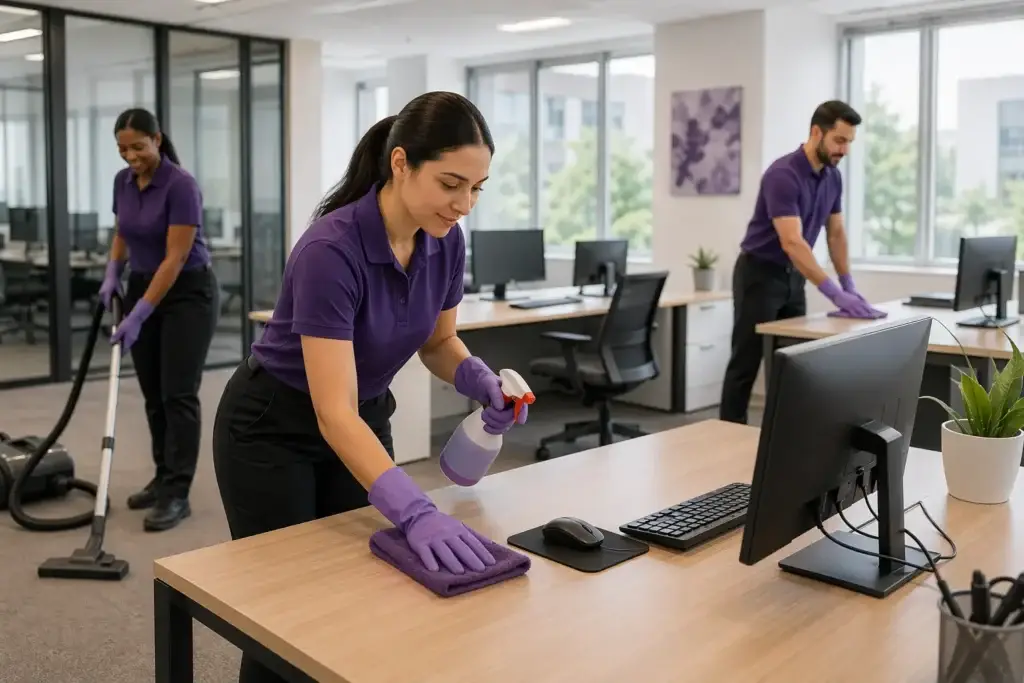
A typical commercial janitorial scope covers:
- Emptying all trash and recycling, replacing liners
- Restroom cleaning and restocking (soap, paper towels, tissue)
- Vacuuming carpeted areas and traffic lanes
- Sweeping and mopping hard floors
- Wiping break room counters, sinks, tables, and appliance exteriors
- Disinfecting shared touchpoints: door handles, push plates, light switches, elevator buttons, shared equipment
- Spot-cleaning interior glass, entry doors, and partition glass
- Tidying reception and common areas
- Reporting building issues found during the visit (leaks, burned-out bulbs, damaged fixtures)
That last one matters more than people expect. A crew that is in your building every night sees problems before you do, and a vendor who trains staff to report them is quietly saving you maintenance money.
What commercial cleaning actually means
Commercial cleaning is the umbrella term for any professional cleaning of a non-residential space. In practice, when a business says “we need commercial cleaning,” they usually mean work that goes beyond the nightly routine:
- A detailed reset before a janitorial contract begins, so the recurring visits start from a clean baseline
- Periodic deep work: interior windows, vents, high dusting, light fixtures, baseboards, detailed restroom work, appliance interiors
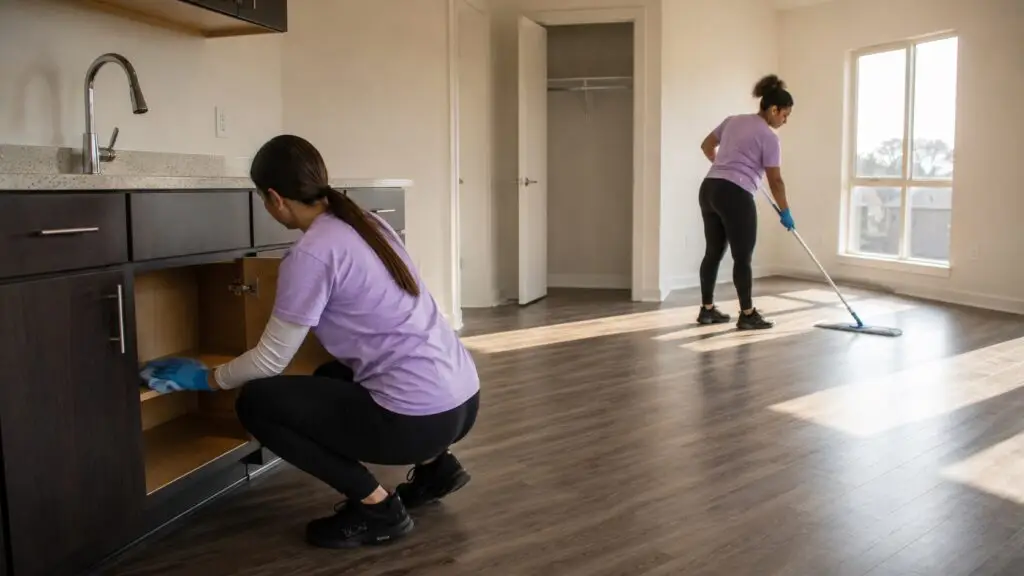
- Move-in and move-out cleans for offices, suites, and units changing hands
- Event and one-time cleans around an opening, an inspection, a client visit, or a seasonal push
- Specialty work such as carpet and upholstery cleaning
The confusing part is that “commercial cleaning” is also the correct industry label for the whole category, janitorial included. So when a vendor advertises commercial cleaning and janitorial services together, they are usually signalling that they do both the recurring upkeep and the periodic deeper work, rather than only one.
Side by side: how the two differ
Scope
Janitorial scopes are narrow and repeatable by design. Every visit does the same list. Commercial deep cleaning scopes are wider and vary by job, because the whole point is addressing what routine work cannot reach.
Schedule
Janitorial is recurring: nightly, three nights a week, weekly. Commercial deep work is periodic or one-time: quarterly, twice a year, or triggered by an event like a renovation or a tenant change.
Staffing
Good janitorial service uses the same small crew on your building every visit, because familiarity is what produces consistency. They learn your alarm, your layout, which conference room is always booked, which restroom takes the most abuse. Deep cleaning jobs are often larger crews for a single longer visit.
Supplies and equipment
Janitorial contracts frequently include consumables, meaning the vendor supplies and restocks your soap, paper towels, tissue, and liners. This is worth asking about explicitly, because it is a real line item and vendors differ. Deep cleaning jobs bring specialized equipment for the specific task instead.
Contracts
This is where businesses get burned. Recurring janitorial has traditionally been sold on long contracts, sometimes multi-year, with automatic renewal and awkward exit terms. Deep cleaning is normally job-by-job. Plenty of businesses sign a long janitorial agreement without realizing there was a month-to-month option available from a local provider.
Which one does your business actually need?
You likely need recurring janitorial service if
- Staff or customers are in the space most days of the week
- You have shared restrooms that get meaningful daily use
- Trash and recycling build up faster than staff can reasonably handle
- Your entryway, lobby, or showroom is part of how clients judge you
- Someone on your team is currently cleaning as an unofficial part of their job, which is almost always the most expensive cleaning arrangement a business can have
You likely need commercial deep cleaning if
- You are starting service with a new vendor and the space has not had a professional reset
- You just finished construction, renovation, or a buildout
- You are taking over or handing back a suite
- An inspection, audit, client visit, or open house is coming
- Your current routine cleaning looks fine at eye level but the vents, baseboards, and high surfaces tell a different story
Most businesses need both
The pattern that works for the majority of Cincinnati and Northern Kentucky offices is straightforward: one deep reset to establish the baseline, then a recurring janitorial schedule to hold it, with a periodic deep clean once or twice a year to catch what routine work does not reach. Buying only recurring service on a neglected building means paying maintenance rates for restoration work, and it usually ends with both sides unhappy.
What to ask any commercial cleaning or janitorial vendor
These questions separate serious providers from the rest, and they cost nothing to ask:
- Are your cleaners W-2 employees or subcontractors? This determines who is accountable, who carries the insurance, and how much turnover you will see in your building.
- Are they background checked? If people are in your space after hours with keys and alarm codes, this is not optional.
- Are you licensed, bonded, and carrying commercial liability insurance? Ask for the certificate, not just the claim.
- Will it be the same crew each visit? Rotating strangers through your building is the single most common cause of inconsistent results.
- What exactly is on the scope, in writing? A real vendor hands you a task list. A vague verbal promise is how expectations drift.
- Who supplies consumables? Soap, paper, liners. Get it in writing either way.
- What is the contract term, and how do I leave? Ask about auto-renewal specifically.
- What happens when something is missed? A stated response window is worth more than a satisfaction slogan.
- Can you work around our hours? After-hours and weekend access matters more for some businesses than the cleaning itself.
Common mistakes businesses make
- Buying on price per visit alone. Two quotes are only comparable if the scopes match. They usually do not.
- Starting recurring service without a reset. The crew inherits a backlog they were never scoped or paid to fix, and quality complaints start in month two.
- Signing a long contract to get a lower rate. Sometimes correct, often not. Find out whether month-to-month is even on the table before you trade away flexibility.
- Not naming a single point of contact. When five people can leave notes for the cleaning crew, the scope quietly expands and nothing is anyone’s fault.
- Assuming janitorial includes deep work. Vents, high dusting, interior windows, and appliance interiors are usually separate. Read the task list.
- Letting the scope go stale. Businesses change. If you added staff, changed your floor plan, or shifted to hybrid schedules, your cleaning scope should have changed too.
How this works at Jeannie’s
We handle both sides for businesses across Greater Cincinnati and Northern Kentucky: recurring janitorial upkeep and the periodic deeper work that keeps the baseline from slipping. Our cleaners are W-2 employees rather than subcontractors, they are background checked, and we are licensed, bonded, and insured. We do not require long-term contracts, and we schedule around your business hours rather than the other way around.
If you are comparing vendors right now, the least risky way to evaluate us is to let us clean before you commit. Our first commercial clean is free, with no obligation, so you can judge the work rather than the sales pitch.
You can see the full scope on our commercial office cleaning page, read what clients say, or check whether we cover your part of the region.
Not sure which one your building needs? Tell us about your space and we will tell you honestly, including when the answer is less service rather than more. Request a free commercial quote or call (859) 750-6618.
Is janitorial the same as commercial cleaning?
Not quite. Commercial cleaning is the umbrella term for all professional cleaning of non-residential space, and janitorial service is one type of commercial cleaning: the recurring, routine upkeep. In everyday use, businesses say “janitorial” to mean the nightly or weekly routine and “commercial cleaning” to mean the deeper or one-time work. A vendor advertising both is telling you they do the routine schedule and the periodic deep work.
Which does my business need first?
Almost always a deep reset first, then recurring service. Starting a routine janitorial schedule on a building that has not had a professional clean means the crew is fighting accumulated buildup with a scope and a timeframe designed for maintenance. Reset the baseline once, then hold it. Businesses that skip this step usually report quality problems within the first month or two.
Do I have to sign a long-term contract for janitorial service?
Not with every provider. Long multi-year agreements with automatic renewal are common in the industry, particularly with national franchises, but they are not universal. We do not require long-term contracts. Before you sign anything, ask directly whether month-to-month is available and how the cancellation terms work, including auto-renewal.
What is the difference between a janitor and a commercial cleaner?
In practice the distinction is about the work pattern, not the person. Janitorial staff service a building on a repeating schedule and often handle light building-upkeep reporting alongside cleaning. Commercial cleaning crews are typically brought in for a defined project or a deeper scope. The same trained employee may do both kinds of work depending on the day.
Should cleaning happen during or after business hours?
It depends on your operation. Offices and professional practices usually prefer after-hours or overnight work so the space is ready in the morning and nobody is vacuuming past a client meeting. Retail and food service typically want after-close. Some facilities benefit from a daytime presence for restroom and common-area touch-ups plus an after-hours full clean. Any vendor worth hiring will schedule around your hours rather than making you fit theirs.
Who supplies soap, paper towels, and trash liners?
This varies by vendor and it belongs in your written agreement. Some janitorial contracts include consumables in the rate, some bill them separately, and some expect you to stock everything yourself. It is a genuine line item, so confirm it before you compare two quotes, because a lower quote that excludes consumables may not actually be lower.
How often should a small office be cleaned?
The main drivers are headcount, foot traffic, and whether you have shared restrooms and a kitchen. A small professional office with a handful of staff and light client traffic is often well served by weekly or twice-weekly service. Higher headcount, public-facing traffic, or shared restrooms usually push toward three nights a week or nightly. If restrooms are the recurring complaint, frequency is almost always the fix.
Are your commercial cleaners insured and background checked?
Yes. Our cleaners are W-2 employees rather than subcontractors, every one is background checked, and we carry commercial liability insurance and are licensed and bonded. We are happy to provide the insurance certificate before work begins. If any vendor hesitates on this question, treat it as an answer.
Can one company handle both our routine cleaning and occasional deep cleans?
Yes, and there are practical advantages. A single vendor already knows your building, your access, and your problem areas, so the deep clean targets what the routine schedule cannot reach instead of rediscovering your floor plan. It also means one point of accountability when something is missed, rather than two vendors pointing at each other.
What should I do if our current cleaning quality has slipped?
Start by rereading the written scope, because the most common cause is a scope that never changed while the business did. If the work genuinely is not being done, ask whether your crew has changed, since high turnover is the usual culprit. Raise it once, specifically and in writing, with a clear response window. If nothing improves after that, the problem is structural and it is time to get comparison quotes.
More commercial cleaning guides
This guide is the starting point. These go deeper on the specific decisions and the industries we work in most:
- Office Cleaning Services: What’s Actually Included — the full scope, area by area, and what routine service does not cover.
- How to Choose an Office Cleaning Company — the nine questions worth asking, and how to compare quotes that are not comparable.
- How Often Should You Have Your Office Cleaned? — what actually drives frequency, and how hybrid schedules changed the maths.
- Event Cleaning Services — pre-event, during, and post-event, plus the venue rules that catch people out.
- Retail Store Cleaning — storefronts, fitting rooms, and the winter floor problem.
- Medical & Dental Office Cleaning — where the general and clinical boundary sits, and why it matters.
- Restaurant & Food Service Cleaning — who is responsible for what, and what needs a licensed specialist.
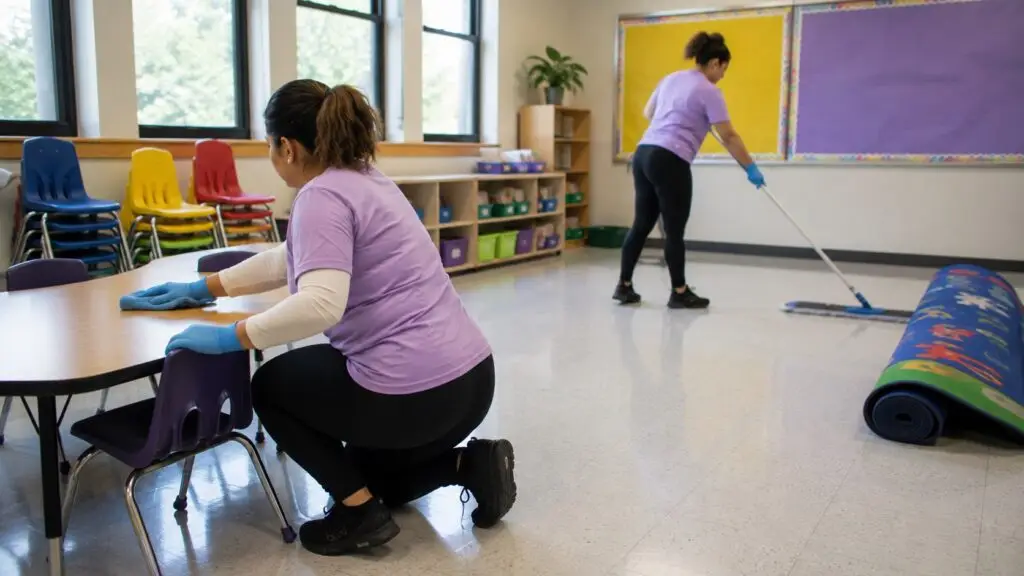
- Church, School & Daycare Cleaning — vetting, illness season, and working alongside volunteers.
- Apartment Turnover Cleaning — a property manager’s guide to scope, sequencing, and same-day turns.
- Gym & Fitness Studio Cleaning — locker rooms, equipment chemistry, and rubber flooring.
- Salon & Spa Cleaning — the regulated boundary, product residue, and scheduling around the book.
Or see the full commercial office cleaning services we offer across Cincinnati and Northern Kentucky.
Ready for a Cleaner Workspace?
Get a free, no-obligation commercial quote. No contracts, and your first clean is on us.